
Flashbulb Memories
For November 22nd, the anniversary of the Kennedy assassination

The photographic flash lends itself most evocatively to the notion of flashbulb memory, the phenomenon in which an intersection of personal memory with the occurrence/reporting of a public (often traumatic) event causes that memory to be so vivid as to be of ‘photographic quality’. It is why, many years later, people report detailed descriptions of the circumstances in which they learned of the event: where they were, what they were doing and with whom, what they were wearing, what song was playing on the radio, and more.1
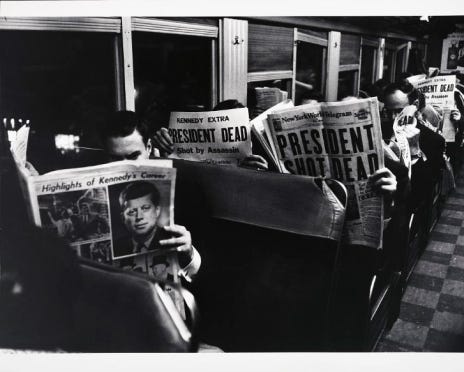
Although the phenomenon had been observed at least as early as the decades following the Lincoln assassination, it was not until 1977 that psychologists Roger Brown and James Kulik proposed the term flashbulb memory, a photographic metaphor, to emphasize the enduring perceptual sharpness that attends such memories.2 They cited the Kennedy assassination on November 22, 1963 as the “prototype case” and it is certainly true that those of us who remember that day tend to view it as our personal instance of flashbulb memory.
Flashbulb/Flashback
At first glance, and given that ‘trauma’ tends to run through both phenomena, there seems to be a contradiction between the perceived accuracy of flashbulb memories and the loss of ‘contextual’ memory associated with flashbacks. While the main difference resides in where the trauma is ‘located,’ there is a further consideration that may bring flashback and flashbulb into fascinating contrast. The accuracy that we believe attaches to a flashbulb memory has – in the decades following Brown and Kulik’s work – been shown to be doubtful.
A number of studies have shown that flashbulb memories tend to undergo changes between one and three years after the event, while at least one psychiatrist, Bessel van der Kolk, made a direct comparison between flashbulb and flashback. Kolk found that flashbulb memories, although experienced as sharp and detailed, are subject to “distortion and disintegration over time.” Kolk noted, for example, that people’s recollections of the Challenger disaster were found to have undergone considerable revisions after a number of years, this in contrast to the flashback memories of PTSD sufferers:
“Clinical observations of people who suffer from PTSD suggest that there are significant differences between flashbulb memories and the post-traumatic perceptions characteristic of PTSD. As of early 1995, I could find no published accounts in the scientific literature of intrusive traumatic recollections of traumatic events in patients suffering from PTSD that had become distorted over time, naturally or by manipulation, either in an experimental or in a clinical setting.” (see Bessel van der Kolk, “Trauma and Memory,” Wiley online library: 2002)
In a paper using 9/11 as its case study (also headed by Hirst and Phelps), researchers found that taken together, previous studies were at variance as to whether the rate of ‘forgetting’ for flashbulb memories “slows or accelerates after the first year.” But Hirst et al. note the following key difference between flashbulb and ordinary memory:
“…flashbulb memories and ordinary autobiographical memories differ not in their rate of forgetting, but in the confidence with which they are held, with confidence in flashbulb memories remaining high, even as the memories are forgotten. Confidence in ordinary autobiographical memories declines as the memories are forgotten.”
And intriguingly, that confidence extends to the inconsistencies that begin to appear in a flashbulb memory:
“once an inconsistency emerges, usually within the first year, it tends to be repeated thereafter. These memory errors often involve time slice confusions, that is, the tendency to confuse the second or third time one heard news about the FBM-eliciting event with the first time.” (Hirst & Phelps, 2017)
These are fascinating results. One further (and admittedly, lay) explanation for the tenacity with which we cling to flashbulb memories, not ‘seeing’ the inconsistencies, must reside in the nature of flashbulb itself. In other words, what is really at play (and more so in flashbulb than other memory phenomena), is our desire for its accuracy, rather than its actual accuracy.
But our confidence in what is surely imperfect recollection cannot be explained solely by the emotional content or power of these memories. In fact, Hirst et al. found that, over time, emotional memory (what we felt when we heard the news) fared more poorly than the ‘facts’ of our hearing of the event – where we were, what we were doing, etc.
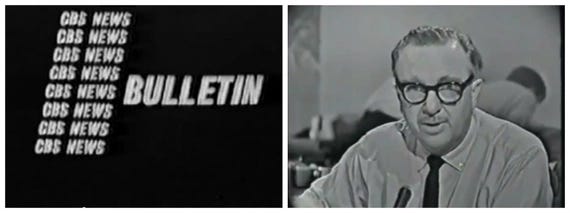
If it is not about the emotional content of the memory itself, perhaps it is partly about our longer-term emotional attachment to it. In other words, the way such memories are constitutive of our individual and collective identities. For surely, the confidence we feel in flashbulb memories derives from two key factors relating to the types of events that create them: 1) that they are shared; 2) we are constantly told that we remember them. Through what Hirst et al. term the “memory practices” of a culture (news media, public ceremonies, films, novels, etc.) we are, at various cultural moments, reminded to remember.
In November 2013, the fifty-year anniversary of the Kennedy assassination, I was in London. I heard from numerous school friends on Facebook and elsewhere. We, the aging baby boomers, exchanged our lightbulb memories without concern for matters of accuracy.
The anniversaries of particular events – one year, ten years, twenty years, fifty years later, often extensively covered by the media, prompt bouts of public remembrance, often for ideological purposes that we may not even support. We, in return for our participation, are given fragile reassurance that our own pasts, our memories, matter. Perhaps we - the ones who do not forget - will not be forgotten. And yes, we are granted another comforting round of sharing. We commune with others, recall people we may not have seen in years, and that sense of shared commemoration makes humans feel less lonely.

In retrospect (to November, 2013), I believe I was vaguely aware that my memory had degraded over the years. But it didn’t matter. What mattered was I had a story to tell myself, my friends, my son who of course was not born when the event occurred. If we leave the neuroscientists for a moment, and return to the historians, we may recall Foucault’s remark about his historical writings: “I am well aware that I have never written anything but fictions. I do not mean to say, however, that truth is therefore absent.”
To borrow loosely from Foucault, in that grey November 2013 I was not recovering a demonstrable ‘truth’ about the event or my memory of it. I was creating a truth from scraps of truths and fictions. I was celebrating memory for what it really is: a representation. A collection of stories. That I, like many others, should feel so confident in my recollection fifty years after the event, was perhaps nothing more than proof of Joan Didion’s famous dictum: “we tell ourselves stories in order to live.”
So, without realizing it at the time, I was engaged in something far from the events of November 1963 or any other well-known flashbulb memory. I was simply showing that memory, for all its imperfections, is how we continually reconstitute ourselves in the world.
I was remembering that I remember. Keeping faith with memory. Convincing myself that I have always remembered. Hoping that I might always remember. Trying to stay alive.
“Flashbulb memory-eliciting events studied to date include assassinations and other politically charged proceedings, major public occasions, such as the World Cup, and national disasters, such as earthquakes. Although most studies investigate negative events, positive events can also elicit FBMs, e.g., the fall of the Berlin Wall. The public does not need to be as large as a nation. People can have FBMs of an event experienced within a family setting, such as learning of the death of a parent.” (See William Hirst and Elizabeth A. Phelps, “Flashbulb Memories” in Current Directions in Psychological Science, 2017)
See Roger Brown and James Kulik, “Flashbulb Memories” in Cognition, Volume 5, Issue 1, 1977.