
Double Vision (part 2)
The Stereoscope

Take an object you treasure and place it across the room from where you are sitting, perhaps somewhere in the room equally special. I do the same. Here is the last of my mother’s crystal wine glasses. I have placed it in front of one of Isaac’s childhood paintings, long loved by me - a scene of sun, moon, and mountains on blue sky.
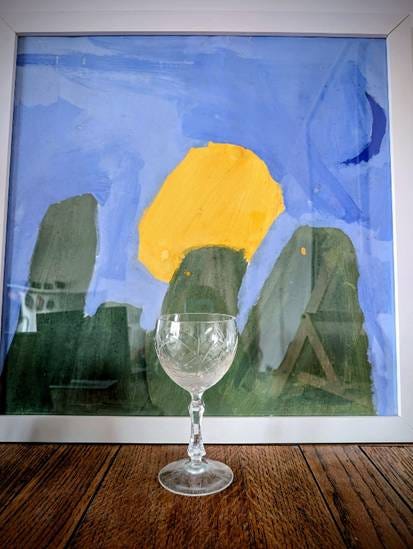
Now, hold up your index finger a few inches from your eyes to align with your object. With your finger raised, close one eye first and then the other. Does your object appear to move each time? If so, you have experienced what is known as retinal binocular disparity, whereby the distance between our two eyes results in each eye seeing the same scene differently from the other, effectively in two different dimensions. I’m right there with you. With my finger still raised, I cover my left eye, and the wine glass (together with mountains, sun, and moon) shifts to the right. I cover my right eye, and it all shifts left.
Now, open both eyes. If, unlike me (see my earlier post, Double Vision), your binocular vision is functioning well, you will find that the two disparate views fuse unproblematically into one image. This process (called stereopsis) occurs in the visual cortex of the brain and enables us to see depth, distance, and the three-dimensional nature of the world.
Kaja Silverman provides a clear explanation of binocular disparity/stereopsis and how these impacted the history of photography:
“Those of us who have two eyes see something slightly different with each of them, in two dimensions. Our brain ascribes these differences to depth and fuses the two images together. Consequently, instead of perceiving two flat images, we generally perceive one three-dimensional image… Binocular disparity serves a crucial spatial function: it allows us to experience the ‘thickness’ of the world.” (Silverman)1
This process, this amazing work of our eyes and brain is ‘unseen’ by us. In other words, looking with our two eyes, we are unaware of the separate images received by each eye: “we do not see them at all, because an internal agency combines them, over which we have no control.” (Silverman)
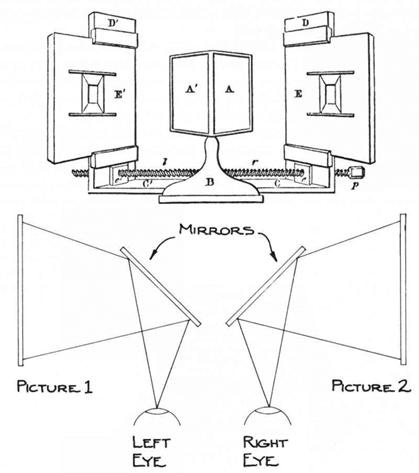
In 1838, Charles Wheatstone created the stereoscope, an “optical device that exploited” the “blind spot” produced by our natural binocular disparity and the brain’s resolution of it: Wheatstone deployed mirrors to recreate the retinal images (i.e. a reflection of the different images received by the viewer’s two eyes), thereby ‘showing’ us what we normally fail to see: the two images prior to the brain’s resolution of them.
It was not long before Wheatstone’s device crossed over to photography:
“In 1849, David Brewster invented the first lens-based stereoscope, in 1851 Jules Duboscq began making stereographic daguerreotypes, and in 1854, George Swan Nottage founded the London Stereoscopic Company for the production of stereoscopes.” (Silverman)
The London Stereoscopic Company was the first to mass-produce not only stereoscopes but also the images produced by them, in the form of stereoscopic slides and cards. We, living our brief 21st-century lives, are used to the regular wonders and anxieties produced by new technologies. Some might say we are punch drunk now, or sleepwalking into futures beyond human management. But our tendency to think we are the first to experience dizzying change always gets the better of us. We have forgotten, for example, the initial impacts of photography itself, and for our purposes here, the stereoscope.
With its promise of three-dimensional ‘realism,’ stereography enjoyed great popularity during the late nineteenth and early twentieth centuries. Within two years of the founding of the London Stereoscopic Company (and its motto, no home without a stereoscope), the firm had sold half a million devices and was already offering 10,000 slides. William C. Darrah, a later enthusiast, would estimate that between 1860 and 1890, some 12,000 stereo-photographers produced up to 4.5 million images to feed the public desire for ever more stereographs. (Darrah, The World of Stereographs, 1977)
Most curiously, and as Silverman points out, here was photography promising the ‘truest’ of images by making use of an invention that effectively “demonstrated the unreliability of human vision” (our retinal binocular disparity). Although ostensibly ‘at home’ in its contemporary context of realism and positivism, stereoscopy simultaneously deconstructed the notion of a “single, ideal eye” upon which our received ideas about perspective depended. (Silverman, and Laura Burd Schiavo quoted by Silverman)2
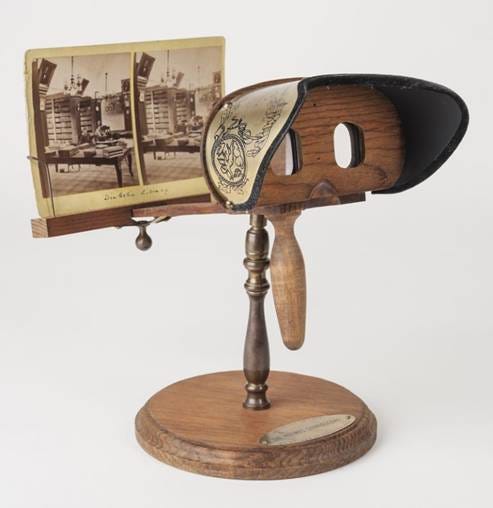
During the heady days of stereoscopy, Oliver Wendell Holmes designed his own device and wrote three essays about the stereoscope, each of which developed his general reflections on the still young technology of photography, together with his passion for the stereoscope itself. In the first of these, “The Stereoscope and the Stereograph,” published by Atlantic Monthly in 1859, Holmes begins with an appreciation of the new medium itself via an extended discussion of the daguerreotype:
“…this triumph of human ingenuity… has become such an everyday matter with us, that we forget its miraculous nature, as we forget that of the sun itself, to which we owe the creations of our new art.” (Holmes, 1859).
But here, his specific subject is the stereoscope’s delivery of “twin pictures,” and the disclosure between them of our binocular disparity, of both the similarities and differences in the scenes before our eyes, and recorded by stereo photography:
“A first picture of an object is taken, then the instrument is moved a couple of inches or a little more, the distance between the human eyes, and a second picture is taken. Better than this, two pictures are taken at once in a double camera. (Holmes, 1859)
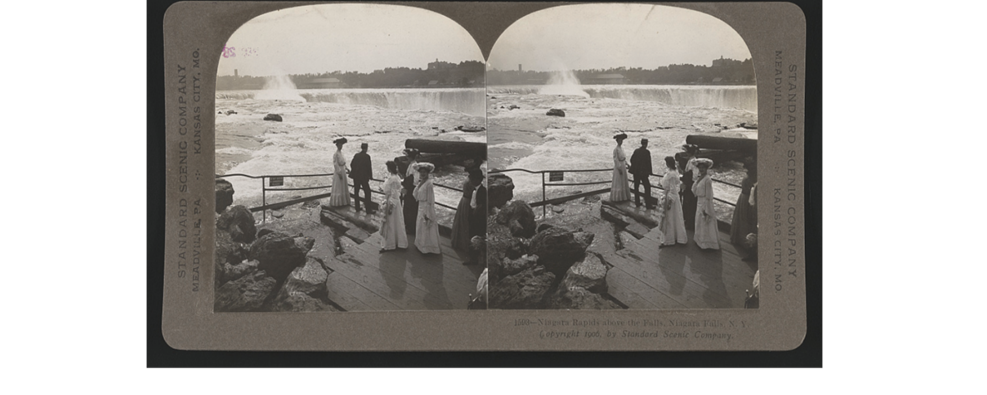
Note the comforting similarities, then the differences, and movement in these two stereocards of Niagara Falls, most notably the altered position and prominence of the rock and spray of water, and the shifting to the margins of the hatted figure on the right of the scene in the first card. And in the second card, a sense that the lone figure on the left, beginning to disappear into the frame, may vanish completely. And of course, all of these are vanished moments. Trusting in the permanence of Niagara, and perhaps recalling our own visits there, we find and lose ourselves in these doubles, and in the past.
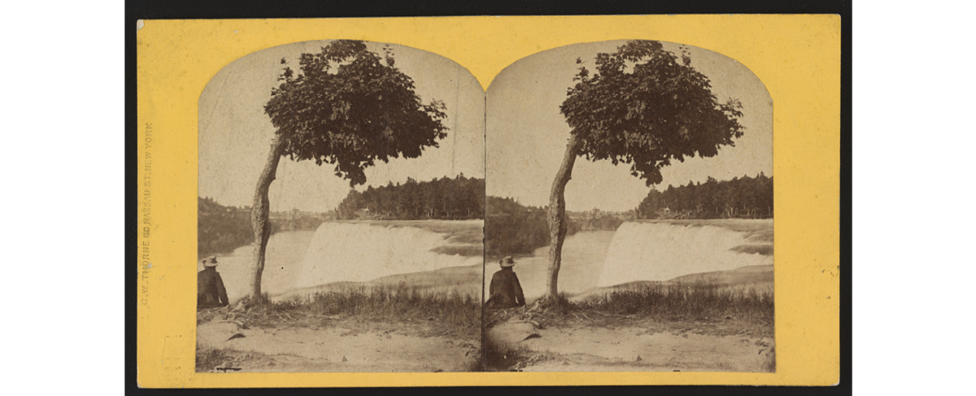
Holmes is enchanted by the play of similarity, difference, and transience in stereographs:
“It is common to find an object in one of the twin pictures which we miss in the other; the person or the vehicle having moved in the interval of taking the two photographs. There is before us a view of the Pool of David at Hebron, in which a shadowy figure appears at the water’s edge, in the right-hand farther corner of the right-hand picture only. This muffled shape stealing silently into the solemn scene has already written a hundred biographies in our imagination. (Holmes, 1859)
“In the lovely glass stereograph of the Lake of Brienz, on the left-hand side, a vaguely hinted female figure stands by the margin of the fair water; on the other side of the picture, she is not seen. This is life; we seem to see her come and go. All the longings, passions, experiences, possibilities of womanhood animate that gliding shadow which has flitted through our consciousness, nameless, dateless, featureless, yet more profoundly real than the sharpest of portraits traced by a human hand… Oh, infinite volumes of poems that I treasure in this small library of glass and pasteboard!” (Holmes, 1859)
At the same time, Holmes regards the stereoscope as an emotive reminder of our brain’s capacity to fuse the separate images received by our two eyes. A reminder of, as Silverman puts it:
“our body’s way of countering the most dangerous of all optical illusions: the illusion that the world is immaterial. The three-dimensional image that our brain produces by fusing two almost identical flat images allows us to ‘feel round’ what we see.” (Silverman)
And it is the stereoscope which comes closest to re-enacting our binocular disparity and its resolution by our mind. In Holmes’s words, the third fused image is how we “clasp an object with our eyes, as with our arms, or with our hands, or with our thumb and finger…we know it to be something more than a surface. (Holmes, 1859)
Yet in the final analysis of Holmes’s essay, Kaja Silverman laments that having shown us the moving ways in which stereo photography ‘re-enacted’ the depth and complexity of human vision whereby the world is rendered in its solidity, Holmes retreats from such an avowedly materialist/phenomenological position. In effect, he retreats from the world itself. In the final section of his essay, Holmes writes:
“Form is henceforth divorced from matter. In fact, matter as a visible object is of no great use any longer, except as the mold on which form is shaped. Give us a few negatives of a thing worth seeing, taken from different points of view, and that is all we want of it.” (Holmes, 1859)
Silverman suggests that Holmes, in this ominous conclusion to his essay, has made photography “the star” of 19th-century rationalization and Cartesian subjectivity rather than a medium that might bring us into a more egalitarian relation with the world, one in which we both ‘give off’ and receive images. Holmes ends by anticipating an abandonment of the material world that gave us its images in favour of collections of those images. He foresees “a comprehensive and systematic stereographic library, where all men can find the special forms they particularly desire to see.” (Holmes, 1859)
Having called for “specialist stereographic collections,” and writing only two years before the start of the American Civil War, Holmes writes with uncanny prescience, mistaking only the location of the imminent bloody battles:
“The next European war will send us stereographs of battles. It is asserted that a bursting shell can be photographed. The time is perhaps at hand when a flash of light, as sudden and brief as that of the lightning which shows a whirling wheel standing stock still, shall preserve the very instant of the shock of contact of the mighty armies that are even now gathering.” (Holmes, 1859)
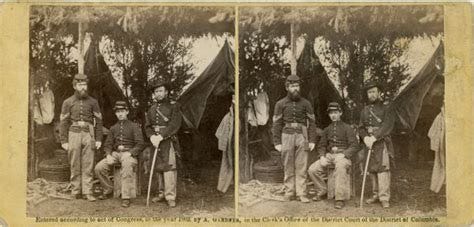
The Civil War photographs and stereo cards produced by Matthew Brady and Alexander Gardner encouraged numerous other photographers who marketed war portraits to soldiers and families:
“As a contemporary reviewer noted, the American Civil War industrialized both death and photography, and often in tandem. ‘America swarms with the members of the mighty tribe of cameristas,’ he wrote, ‘and the civil war has developed their business in the same way that it has given an impetus to the manufacturers of metallic air-tight coffins and embalmers of the dead. The young Volunteer rushes off at once to the studio when he puts on his uniform, and the soldier of a year’s campaign sends home his likeness that the absent ones may see what changes have been produced in him by war’s alarms.” (Silverman, citing a quotation found in Jeff L. Rosenheim, Photography and the American Civil War, 2013)3
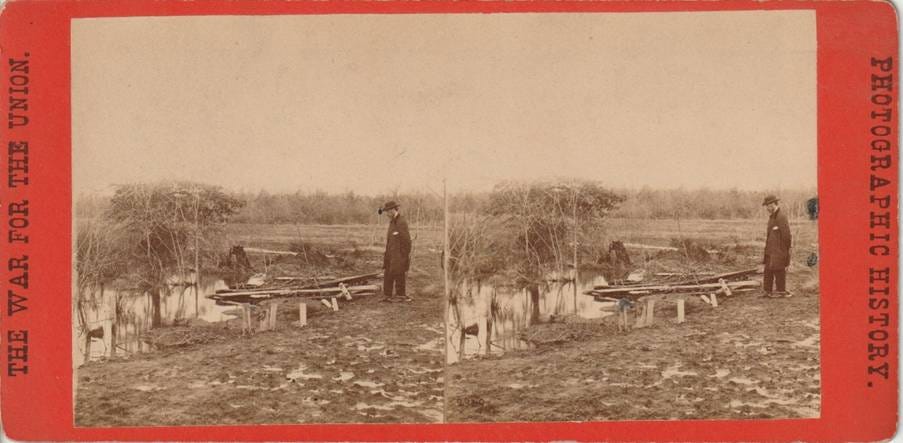
Nowadays, we find old stereocards in antique print or book shops, but the promise of a stereoscope in every home has fallen away. In truth, I had not thought much about these images until my personal experience of double vision and, more recently, reading Kaja Silverman’s account of early photography, a work which continues to renew my love of the medium and its history.
Yet many of us may recall the poignant sequence in Terrence Malick’s Badlands, in which Holly looks through her dead father’s stereopticon at the mix of images he left behind: a canal, a camel boy in front of the Great Pyramid, cows by a fjord, a mother and child, a woman playing piano, a family on the lawn, a soldier whispering to a girl. Public scenes and private ones, a glimpse into worlds wider than Holly, and before Holly. She says, “It hit me that I was just this little girl, born in Texas, whose father was a sign painter and who had only just so many years to live.” The innocent voice-over, given in secrecy, thoughts withheld from her dangerous lover, speculates about the past and an idealized, unknown future. As we tend to do.
Kaja Silverman, The Miracle of Analogy or The History of Photography, Part 1, 2015.
See Laura Burd Schiavo, “From Phantom Image to Perfect Vision: Psysiological Optics, Commercial Photography, and the Popularization of the Stereoscope,” in New Media: 1740-1915, edited by Lisa Gitelman and Geoffrey B. Pingree, 2003.
For an extraordinary stereoscopic display, see the images collected by The Atlantic for its three-part commemoration of the American Civil War. “Photographers also made extensive use of stereo photography, bringing images to the public in three dimensions, for those with access to a stereoscopic viewer. The images collected here are stereo pairs, which will animate when clicked (starting with photo #2), adding a new dimension, and further bringing home the reality of the moment.” (Alan Taylor, The Atlantic, 2012)